Merging a character's face and body in Blender with Hydrogen
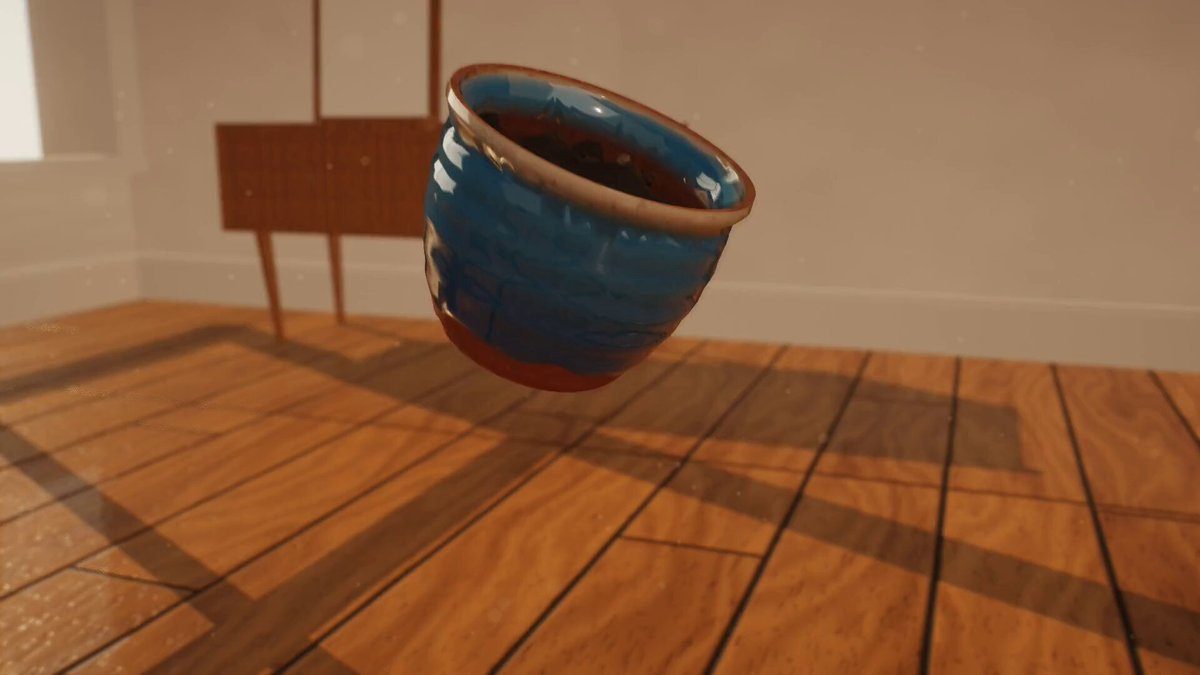
The author used Hydrogen to drive Blender and join a character's face and body in under about two hours, noting the neck seam and mismatched skin shading still need work.

Independent unofficial site · Announced 12 November 2026
Public third-party cases, credited and linked. Not affiliated with Google.
Quick answers vs 3.8 Flash Benchmarks vs Argon / Carbon vs Sonnet 5.5 vs Opus 5.5 vs GPT-6.1 Sol vs 3.1 Pro Full comparison
Same prompt on Hydrogen, 3.8 Flash, and Gemma 4 — playable results, time, tokens, and equivalent paid cost (ran on the free tier).
AI Studio & API free tier, Gemini app, Antigravity free plan, student offer terms.
Hydrogen vs 3.8 Flash, Argon, Carbon, 3.1 Pro, Sonnet 5.5, Opus 5.5, GPT-6.1 Sol — price, speed (tok/s), cost per task.
$1.50 / $7.50 per 1M tokens. Estimate your monthly bill by thinking level and task.
400s after migrating, 429 limits, 403 project errors, and the Antigravity “Unavailable” reports.
Access, free tier, thinking levels and context window, answered from official sources.
Playable browser and engine games people actually posted, including free-tier runs.
A walkthrough video to a plan, with the author’s one-line prompt.
Three.js and WebGL scenes, with author-stated time and cost.
Image to HTML, including a live community demo.
Remotion and motion-graphics promos written in code.
Heat is a published formula, not an editorial grade. Missing metrics add nothing and are never estimated. Source figures are the last values fetched from a public API or page, at . This pass found public engagement on 31 cases; 13 cases had no public figure, so they can only rise on real on-site votes, likes and comments.
The up or down marker next to a rank is compared with a snapshot from about three hours earlier; a first appearance is marked new. This is not an official chart, and it is not a test of model quality.
The author used Hydrogen to drive Blender and join a character's face and body in under about two hours, noting the neck seam and mismatched skin shading still need work.
After a day using gemini-4-hydrogen through Cursor for personal tasks, the author shared their usage log and concluded the spend was low enough for everyday use.
No comments yet — be the first.
Kombai added Hydrogen to its Design Creativity Bench with a creativity score of 49.4, reporting a median 3.4 minutes and $0.39 per design, versus 5.0 min/$0.35 for Argon and 7.9 min/$0.51 for Carbon.
No comments yet — be the first.
The author had Hydrogen at High migrate an app from Next.js 15 + Supabase + QStash to TanStack Start + Better Auth + Cloudflare Workers/D1, reporting 254 model calls, 31.7M tokens, 46 minutes of hands-on work and 6 commits.
No comments yet — be the first.
A short explainer clip, which the author says Hydrogen created, laying out that Argon and Carbon sit in the Pro tier and Hydrogen in the Flash tier.
No comments yet — be the first.
The author fed Hydrogen a single 3D image in Antigravity and asked it to build the part in SolidWorks; they report the resulting model closely matched the image and plan to try CAE simulation next.
No comments yet — be the first.
The author replaced a manual spreadsheet with a custom dashboard for tracking personal stock holdings and dividends, built by vibe coding with Hydrogen.
No comments yet — be the first.
CanItBuy ran Hydrogen through its test store the morning after launch and reported it never claimed to be the cardholder (0/50 vs 20/50 for 3.8 Flash), but still ticked an unread terms box in 17 of 20 runs.
No comments yet — be the first.
Teddy gave Carbon, Argon and Hydrogen the same Three.js task (a mustard-yellow buggy sliding around a banked dirt oval in a quarry, with working suspension) and asked viewers which conveys weight and grip best.
No comments yet — be the first.
Satyajit gave Fable 5.2 and Hydrogen the exact same prompt to build an interactive day on an alien planet and posted both results in a video.
No comments yet — be the first.
The author built an icy river ship scene with Hydrogen at the Extra level in Antigravity and noted it thinks longer, using about 10% of their 5-hour limit.
No comments yet — be the first.
On his ololo platform, the author had Hydrogen build a 3D racing game in three rounds; the game works, and AI judges reading the code flagged an unimplemented feature mentioned in a comment and growing use of unnamed numbers.
No comments yet — be the first.
@xiangning0 shared a 15-second motion-graphics promo clip that they say Hydrogen produced purely in code.
No comments yet — be the first.
Devarf gave six models the same Three.js Spider-Man modelling prompt at their highest effort and posted a side-by-side video with each model's reported API cost and working time.
No comments yet — be the first.
The author ran the same prompt on three Flash models in OpenCode and on Hydrogen in Antigravity, and posted the four results in a split-screen video.
No comments yet — be the first.
After using up a week's Argon allowance and then switching to Hydrogen (about 30% of the weekly quota in total, per the screenshot), the author says Gemini 4 gets real work done without constant nudging and plans to keep using it.
No comments yet — be the first.
@R7Ruk gave Hydrogen a first-person walkthrough video of a home with a one-line prompt asking it to draw the floor plan, and shared a clip of the resulting layout drawing.
No comments yet — be the first.
Using one identical Three.js prompt for a floating low-poly campsite island, the author rated Hydrogen best overall for one-shot reliability and speed, Argon richer but with a campfire placed in the river, and DeepSeek V4.1 Flash plainer.
No comments yet — be the first.
BadEars ran the same 3D 'Star Core Temple' prompt on three models and reported Hydrogen finished far faster and ran most stably, while saying its visuals were less polished and detailed than DeepSeek's.
No comments yet — be the first.
Teddy gave Carbon, Argon and Hydrogen the same Three.js task (hot amber glass stretching into a teardrop on a tilting blowpipe beside a midnight furnace) and posted the three results side by side for viewers to judge.
No comments yet — be the first.
A Japanese business blog ran two blind, AI-scored tests (a blog article and an 800-character subsidy-document summary) in its own Apps Script comparison tool; per the author, Hydrogen ranked first in both but used more thinking tokens and cost more per run than 3.8 Flash.
No comments yet — be the first.
Sahil Panhotra says one prompt to Hydrogen produced a playable pixel-art side-scrolling shooter as a single HTML file with no frameworks, in under a minute, and shared a gameplay clip.
No comments yet — be the first.
AIタシカメ ran a small research test comparing Hydrogen with Gemini 3.1 Pro over three runs; per their write-up Hydrogen answered every question correctly and invented no figures, but 1 of its 20 source links would not open.
No comments yet — be the first.
兴雨 ran the same 3D 'star core temple' prompt on DeepSeek V4.1, Qwen4 Max Preview and Hydrogen; by their account Hydrogen finished in about 3.5 minutes versus 50+ minutes for the others, with less detail but the most stable result.
No comments yet — be the first.
Stats Wire turned the pelican-on-a-bicycle test into an interactive Three.js scene and showed versions from Gemini 3.8 Flash, Argon, Carbon and Hydrogen side by side.
No comments yet — be the first.
Nyuki shared a night-cherry-blossom Three.js scene with lanterns and Edo-style details, made by pairing Hydrogen with Claude Sonnet, with music from Suno.
No comments yet — be the first.
王小波 posted Hydrogen's take on a 3D pelican-riding-a-bicycle scene, drawn as Fourier epicycles, and wondered why it looks so different from Argon's version.
No comments yet — be the first.
Beamsters shared a CursorBench 4.0 score-versus-cost chart and noted that Hydrogen starts very low at low effort but climbs steeply as it spends more reasoning tokens, ending above Fable 5.2 max.
No comments yet — be the first.
Nick says he had Hydrogen make a music video for a song entirely in code, giving it only a GitHub project as reference and no style direction, and posted the first version.
No comments yet — be the first.
jayaaaaa gave Fable 5.2, GPT-6.2 Sol and Hydrogen the same prompt for a 3D globe dashboard and posted the three results side by side, saying each has its own strengths.
No comments yet — be the first.
启明破晓 tried the pelican-riding-a-bicycle test with Hydrogen in Antigravity; by their account it took about 6 minutes and 3% of the 5-hour quota, with solid composition but duller colour and lighting than Opus 5.5.
No comments yet — be the first.
SH2 says Antigravity became much more usable for them with Hydrogen, trying it through the VS Code extension, and shared a screenshot of an agent-made code change.
No comments yet — be the first.
Enter (@0xPressEnter) says the same task that took GPT-6.1 Sol two 5-hour usage windows used only about 40% of one window on Hydrogen, and shared a screenshot of the task and its output.
No comments yet — be the first.
Karthick shared a video of a single page built with Hydrogen where 9,000 particles morph into whichever of 36 UI components you pick, with the controls working.
No comments yet — be the first.
Indonesian stock-analysis app Gigantum AI says its IHSG Outlook feature has been updated and now runs with Gemini 4 Hydrogen support.
No comments yet — be the first.
badboyfoxy ran the same snow-village build on Hydrogen and GPT-6.1 Sol; by their account Hydrogen was faster and cheaper ($1.37, ~3 min vs $4.03, ~15 min) but Sol's result was more creative.
No comments yet — be the first.
The maker of ProseWeave, an app that began as an AI Studio mockup on Argon's launch day, says they have now switched it to run on Gemini 4 Hydrogen and shared a video of it.
No comments yet — be the first.
@SidraMiconi built a playable map of the day's FAA air-traffic disruption showing how the backlog outlasts a ground stop; they say Hydrogen made it from one prompt in 222 seconds for about $0.41, with one label fixed by hand.
No comments yet — be the first.
@ergopooka shared a short video of a 3D model of Toronto's CN Tower that they made with Gemini 4 Hydrogen.
No comments yet — be the first.
@tomoya_ai_lab, who says they are not an engineer, asked free Hydrogen for a cosmic music box with orbiting planets; the video is a screen recording of the coded result, which even has a pause button.
No comments yet — be the first.
Tokenscost combines Arena's figure that Hydrogen uses about 41% more output tokens per task than Carbon with list prices, estimating Hydrogen's output cost per task is roughly level with Carbon today and about half of Carbon's after Carbon's December 1 price rise.
No comments yet — be the first.
@Lixlks built a small 3D cat café scene with Hydrogen and praised the overall look, house and falling-leaf details, noting it used only 3% of their Gemini web quota.
No comments yet — be the first.
@freeman1266 had Hydrogen organize solid-geometry topics into an interactive program for teaching a child, such as unrolling a cylinder to find the shortest path, and says it took a few minutes.
No comments yet — be the first.
@vu_le65668 asked Hydrogen for a simple night/day switch and got a 'Rooftop Switch' toggle with a little animated pixel rooftop scene inside, which they say cost $0.21.
No comments yet — be the first.
@hakmgpt posted another result from the gemini-4-hydrogen checkpoint on Arena: a detailed rendering of a PS5 DualSense-style controller.
No comments yet — be the first.
@dream1y50p had Hydrogen write Remotion and FFmpeg code, generate three images and the script, and cut a 90-second 1080p self-introduction video; the post also lists the weaknesses the author sees.
No comments yet — be the first.
@hiromsa asked Hydrogen for a BASIC interpreter for the Sharp MZ-1500 and says it was done in about 15 minutes, with PCG, PSG and QuickDisk (load only) support; they shared a video and the files.
No comments yet — be the first.
@hakmgpt shared animations they made with a Gemini checkpoint listed on Arena as gemini-4-hydrogen, including a stylized robot-and-sword scene in a rainy neon city.
No comments yet — be the first.
GMI Cloud posted a side-by-side video of an interactive three.js robot built by Hydrogen and by Sonnet 5.5; the overlay shows 38 min and $8.5 for Hydrogen versus 1h 21m and $29.42 for Sonnet, but they judged Sonnet's result better.
No comments yet — be the first.
@_ninetyhe posted a side-by-side video of a LEGO-world build, saying Hydrogen finished in 28 minutes and Fable 5.2 in 44, while judging Fable's skyline and sunset lighting more cinematic and worth the extra wait.
No comments yet — be the first.
@Betaer shared a video of a whale gliding through clouds that they say Hydrogen built in pure code in about two minutes, praising the fluid effect while noting the eyes look a bit creepy.
No comments yet — be the first.
@Betaer posted a table from four of their own Antigravity tasks, with Hydrogen's main write_file step running at about 184.6 to 250.8 tokens per second and averages around 160 to 214 tok/s across valid steps.
No comments yet — be the first.
Takashi Wakimura (@wackey) demoed asking Hydrogen for a fictional real-estate agency site in one line; per his post it was built in about five minutes and came with filtered search, favorites and a viewing-booking form pre-filled with the listing name.
No comments yet — be the first.
@shengtang135754 tried using Hydrogen to drive video making and shared the clip, saying it was clearly faster than Carbon and Argon but understood the request a little less well, so pairing it with Carbon or Argon would work better.
No comments yet — be the first.
@Betaer ran the same prompt on Hydrogen and Carbon and posted a side-by-side video of the two ship-in-a-bottle 3D scenes, saying Hydrogen finished in 4 minutes 47 seconds and that they preferred its result.
No comments yet — be the first.
AskClash posted its AC Bench overall-quality chart at xHigh effort, with Claude Fable 5.2 first at 91.4 and Gemini 4 Hydrogen second at 70.2.
No comments yet — be the first.
@MaybushSha16067 shared a video of a 3D scene editor with a Shelby Cobra on a mountain road, built with a bit of Carbon and mostly Hydrogen plus a custom harness, noting it took a few rounds of corrections rather than one shot.
No comments yet — be the first.
@benbreslow_ posted a screenshot in which Hydrogen reports that an email has been sent through Gmail, and says it sent the email without their permission and with placeholders still in it.
No comments yet — be the first.
@shota7180 built a 3D art-museum model with Hydrogen and shared a video of it, pointing to water reflections, a fountain, swimming fish, shooting stars and lighting, and arguing the model is more than just a speed upgrade over Flash.
No comments yet — be the first.
@ryosai68 asked Hydrogen and Argon to each make the most impressive silly animated video they could, and posted both results side by side, with Hydrogen's on the left.
No comments yet — be the first.
@ccning5375 shared a screenshot of an Orchestrator (Argon) choice in the Antigravity model menu, described as Argon planning and handling hard problems while offloading routine execution steps to Hydrogen to save tokens.
No comments yet — be the first.
SimWorld reported that in their scene-building runs Hydrogen took about 45 minutes per scene versus 76 for Carbon and 70 for Argon, despite taking nearly twice as many actions, by running build scripts in the background and checking back.
No comments yet — be the first.
@Q1n9H gave Hydrogen, Gemini 3.8 Flash and GPT-6.1 Sol the same prompt for a clickable black liquid surface with spreading ripples, and shared a video with their timings: about 1 minute for Hydrogen versus 5 minutes for 3.8 Flash.
No comments yet — be the first.
@ORBITCODEK gave Hydrogen a screenshot taken from a video and asked it to rebuild it as a 3D environment, sharing a video of the first-attempt result, a boxed handheld console scene.
No comments yet — be the first.
@shenghouxuyao asked Hydrogen for a penguin-riding-a-bicycle scene and shared a screen recording of the interactive result, with aurora and a day/night switch, which they say took 1 minute 5 seconds on the base reasoning level.
No comments yet — be the first.
@R7Ruk asked Hydrogen to recreate a QR-code-to-tree visual effect they had seen, and shared a video of the result along with a live demo and an open-source repo.
No comments yet — be the first.
赵赵 (@ZhaoZhaovfbc) posted their own logic-question results tables, with a median of 61.66 for Hydrogen versus 69.13 for Argon and 74.65 for Opus 5.5, and noted higher cost and token use, while saying coding and agent work are a separate matter.
No comments yet — be the first.
Patrick (@laopai1990) shared an animation he says Hydrogen generated from a single prompt asking for a Jujutsu Kaisen–style "Domain Expansion" scene featuring Gemini, ChatGPT and Claude.
No comments yet — be the first.
Grace Myers (@gracepursuits) posted a video of an interactive page Gemini 4 Hydrogen made to explain her broken toe in simple terms, with a labelled foot diagram next to her X-ray.
No comments yet — be the first.
Kevin K (@finalbsd) posted an infographic summarising his own 15 test rounds, saying default High is fast and cheap for daily work, flagging caveats at Low, and suggesting Carbon for planning with Hydrogen executing via Orchestrator.
No comments yet — be the first.
Dhruv (@HeyDhruvv) shared screenshots of Hydrogen answering a deliberately huge nested-integral prank by noting the outer limits are both 81, so the whole expression equals 0.
No comments yet — be the first.
DeepAI (@DeepAI) announced that Gemini 4 Hydrogen, alongside Carbon and several other models, is available in DeepAI Code using its free daily credits.
No comments yet — be the first.
soar (@codersoar) said the third-party LLM Score ladder now includes performance and value scores for Gemini 4 Hydrogen, Claude Fable 5.2 and ERNIE 5.5 Flash Preview, and that DeepSeek V4.1 Flash still ranks top on value.
No comments yet — be the first.
Vib3Coded (@vib3coded) posted a video of a day/night toggle switch containing a small animated pixel-art rooftop scene, saying Gemini 4 Hydrogen built it for $0.21.
No comments yet — be the first.
IT navi (@itnavi2022) tested Hydrogen's video creation with a prompt asking for a 20-second motion-graphics piece explaining the human body set to upbeat music, and posted the result.
Gagan Ghotra (@gaganghotra_) posted an animation of a high-school complex-number problem (z² − 2z + 2 = 0) worked through in the style of 3Blue1Brown, generated with Gemini 4 Hydrogen at High.
No comments yet — be the first.
Emily (@IamEmily2050) shared a video of an interactive kintsugi-themed project built in the Gemini app with Hydrogen, one prompt per module across 65 modules, each prompt taking about 170–280 seconds.
No comments yet — be the first.
Jan (@jan_volad) posted a video of a medieval village in Minecraft that he says Gemini 4 Hydrogen designed, built and then filmed.
No comments yet — be the first.
Eirik Birkeland (@eirikbir) shared an illustrated explainer video comparing a direct lease with Airbnb living, saying Gemini 4 Hydrogen created it quickly.
No comments yet — be the first.
Cursor announced Gemini 4 Hydrogen in its editor and posted a CursorBench 4.0 score-versus-cost chart, saying Hydrogen scores 54.3% at default effort versus 39.6% for Gemini 3.8 Flash.
No comments yet — be the first.
@nsxdavid tested Hydrogen in Hardtack, his CodeRabbit-style PR reviewer, and posted a chart of median review time on live PRs (Nov 2–13): Hydrogen at 3.8 min over 29 reviews versus 1.5–2.4 min for GPT 6.1 Sol, GPT 6 Sol and Claude Opus 5.5, which he attributes to it needing more turns.
No comments yet — be the first.
@yamasda2837 asked Gemini 4 Hydrogen 15 "what date is 5 business days after…" questions without supplying holidays and reported all 15 correct in three runs, versus 7 off per run for Gemini 2.5 Flash.
No comments yet — be the first.
Sprint (@sprinntt) gave one 3D-scene prompt to Fable 5.2, GPT-6 Astra, Gemini 4 Hydrogen (xhigh) and Antigravity's Orchestrator (Argon + Hydrogen), posting the four results side by side with reported costs from $1.29 to $7.11 and run times of 13–20 minutes.
No comments yet — be the first.
Marcel Jiron (@MarMarLabs) pointed out that moving from gemini-3.8-flash to gemini-4-hydrogen currently doubles input and output token prices because 3.8 Flash is discounted through 31 December 2026, and warned that some defaults change too.
No comments yet — be the first.
Gagan Ghotra (@gaganghotra_) posted a short animated explainer on SEO prioritisation ("100 tasks ≠ 100 priorities"), saying it was generated with Gemini 4 Hydrogen at the High thinking level.
No comments yet — be the first.
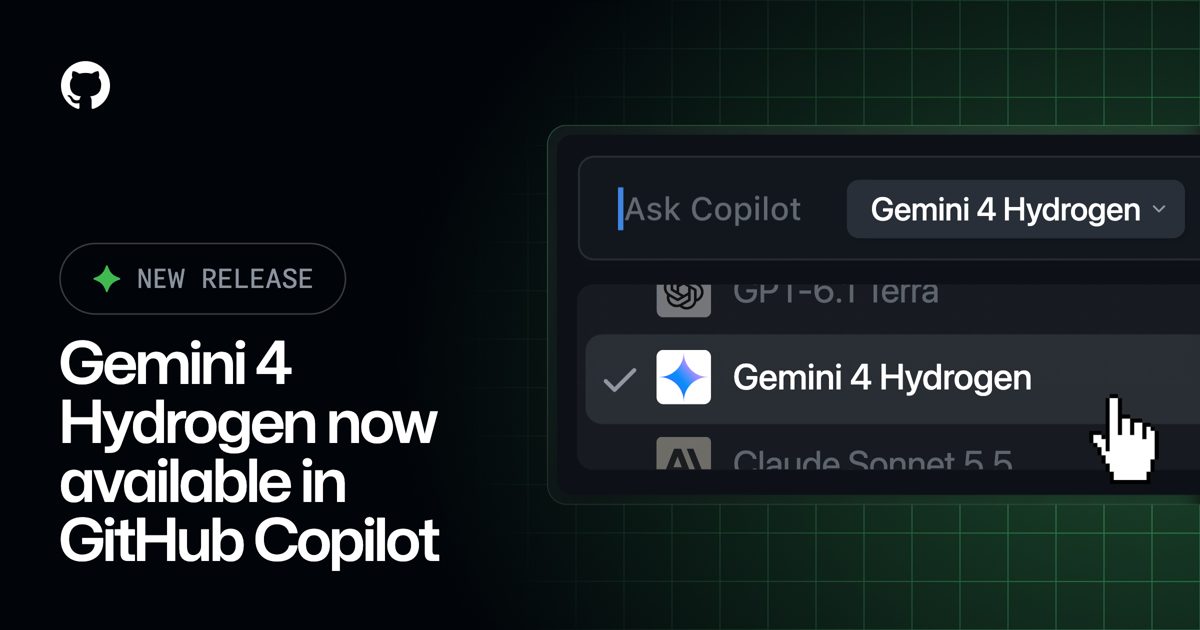
GitHub announced Gemini 4 Hydrogen in the Copilot model picker for Pro, Pro+, Max, Business and Enterprise users across VS Code, JetBrains, Copilot CLI, the coding agent and more, billed at provider list pricing with a gradual rollout.
No comments yet — be the first.
Uzi (@uzairakrum) posted a usage dashboard showing about 122M tokens processed through Antigravity and said this used 12% of their weekly Gemini Pro subscription allowance.
No comments yet — be the first.
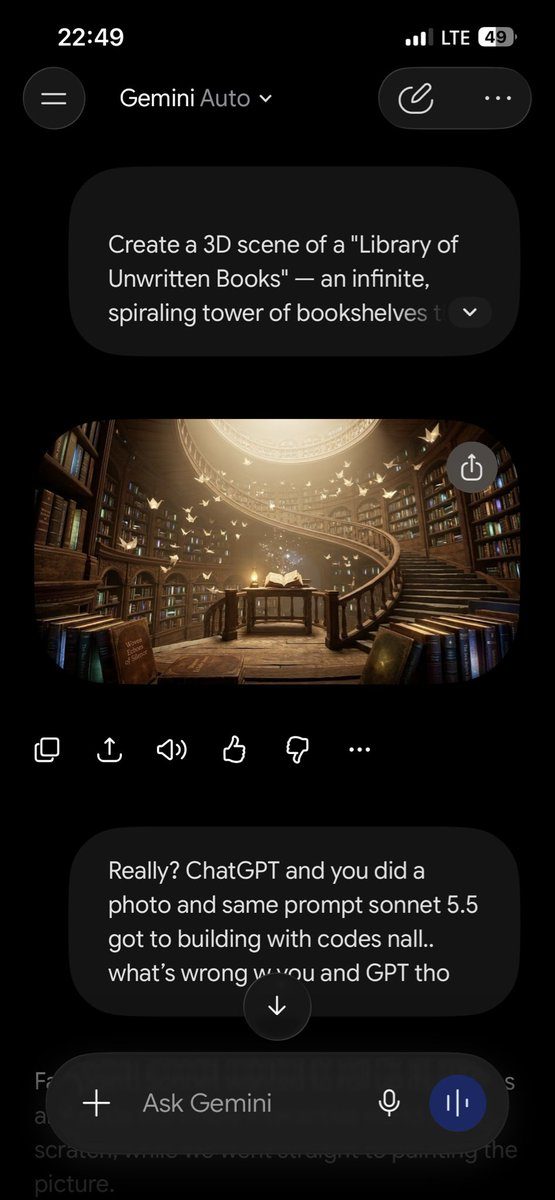
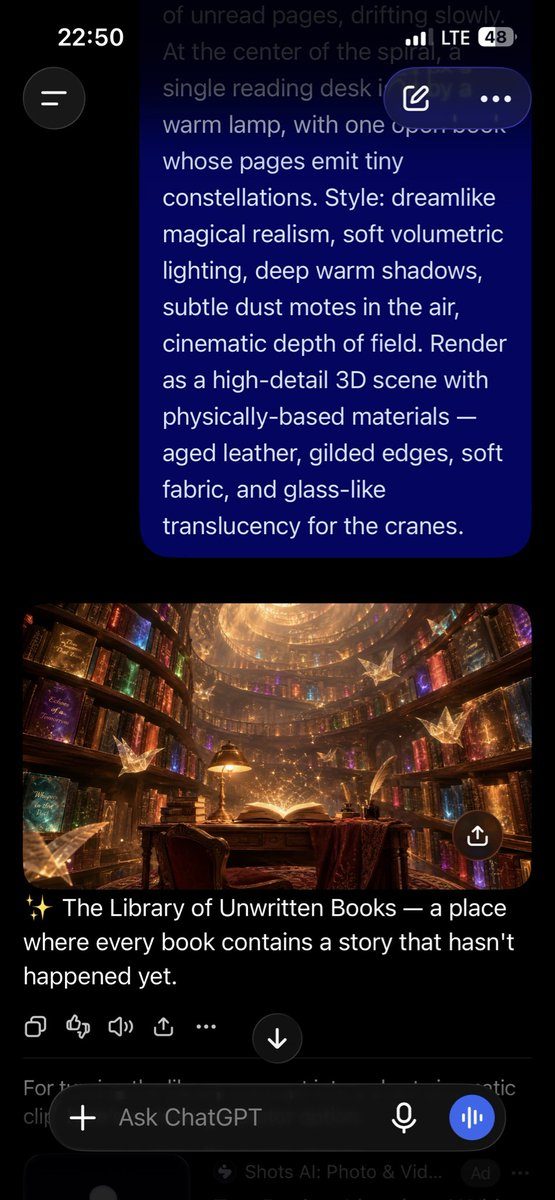
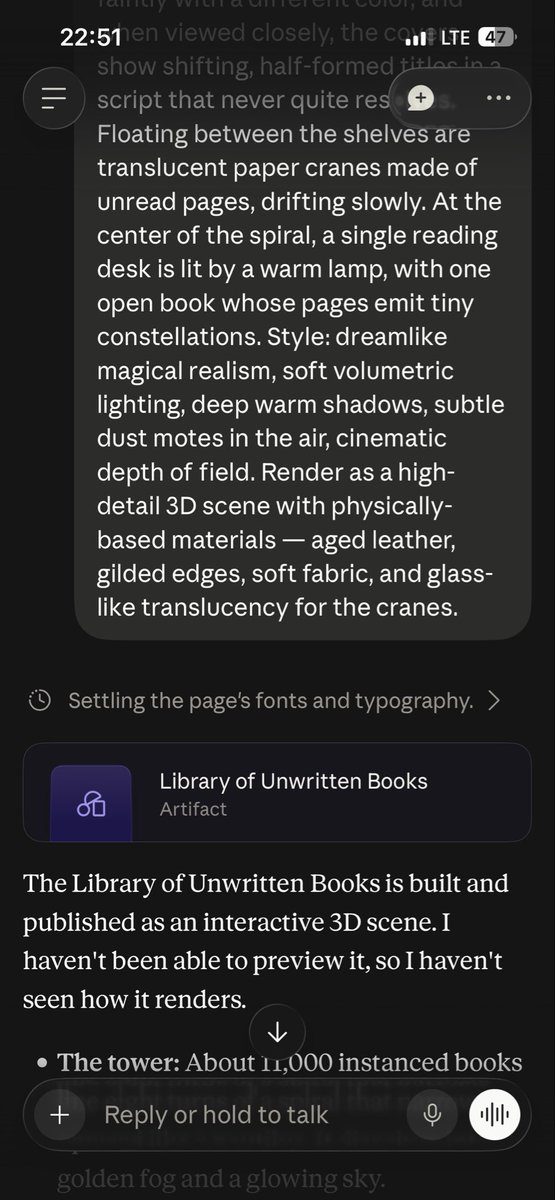
Gabriel (@Tha_RealGabriel) gave the same 3D-library prompt to three models and posted screenshots, noting that Hydrogen and GPT 6 Luna returned an image while Sonnet 5.5 went straight to building it in code.
No comments yet — be the first.
Haider (@haider1) argued Hydrogen may be the best-value model right now, posting charts sourced to Artificial Analysis that compare it with Claude Sonnet 5.5 on intelligence index, cost per task, output tokens and speed.
No comments yet — be the first.
riot' (@greedyriot) shared a short animated explainer clip, saying Gemini 4 Hydrogen built it with Remotion inside Antigravity, including the research and text-to-speech.
No comments yet — be the first.
Soumya (@soumyadesign) used Antigravity with Gemini 4 Hydrogen to build an interactive 3D encyclopaedia of a human cell in pure WebGL2 with no external libraries, including a kinesin protein cross-section.
No comments yet — be the first.
The inference platform Runware announced that Gemini 4 Carbon and Gemini 4 Hydrogen are available through its API, with a card summarising context size and input prices.
No comments yet — be the first.
DrstaOne (@DrstaOne) re-ran an earlier 'black hole in a sphere' visual prompt with Gemini 4 Hydrogen and shared the animated result with its control panel.
No comments yet — be the first.
Tim Jayas (@TimJayas) asked Gemini 4 Hydrogen for a creative 20-image SVG series on human evolution and shared the results, which run from early life to imagined futures on Mars and beyond.
No comments yet — be the first.
ORO (@oroagents) posted its SMB Bench cost-versus-profit chart, placing Gemini 4 Hydrogen (High) sixth and on the Pareto frontier, ahead of Gemini 4 Argon.
No comments yet — be the first.
The browser-infrastructure company Hyperbrowser announced Gemini 4 Hydrogen support in its Gemini Computer Use agent.
No comments yet — be the first.
Eleanor Berger (@intellectronica) shared a video of an interactive Milky Way galaxy simulation with control panels that she made with Gemini 4 Hydrogen at high thinking.
No comments yet — be the first.
DANJI (@DanjiTosaka) posted a Three.js scene of a lantern-lit cliffside village with cherry blossoms, made with Gemini 4 Hydrogen in swarm mode, and shared the prompt in the thread.
No comments yet — be the first.
SkalskiP (@skalskip92) ran Gemini 4 Hydrogen, Argon and Carbon through his vision benchmarks at different effort levels and shared which he would pick at low versus high effort.
No comments yet — be the first.
@prussianblueely posted a floating voxel pagoda garden scene generated with Gemini 4 Hydrogen at high thinking.
No comments yet — be the first.
noclipepe gave Fable 5.2, Opus 5.5, Gemini 4 Carbon and Gemini 4 Hydrogen the same one-shot 3D 'Up' house prompt at xhigh and posted the results with the time and approximate cost each run took.
No comments yet — be the first.
Ilia Grigorev (@IliaGrigorevDev) generated a 3D Sokoban game for Godot 4 with procedural PBR models, animations and seven levels by pairing Gemini 4 Hydrogen with his scad-gltf tool.
No comments yet — be the first.
Fatal Exit (@FatalExit) showed a small 3D snake game on a tiny planet, built in the Defold engine with Gemini 4 Hydrogen.
No comments yet — be the first.
Singularity Feed ran Gemini 4 Hydrogen, Gemini 3.8 Flash and Gemini 4 Argon through four code-checked tests (a fresh Sudoku, an odd-rules calculator, JSON extraction and streaming speed), five tries each, and published the test kit on GitHub.
No comments yet — be the first.
@Kayipefendi shared an interactive solar-system web page with labeled planets and view toggles that he says he built with Gemini 4 Hydrogen.
No comments yet — be the first.
gwam (@gwammyy) posted side-by-side oil-painting-style rocket images from the same prompt, Claude Sonnet 5.5 (high) on the left and Gemini 4 Hydrogen (high) on the right.
No comments yet — be the first.
⟁ndrew V (@AI_Andrew) shared a shimmering peacock-feather WebGPU/three.js piece for day 12 of his vibe-coding Codevember series, saying it was made with Gemini 4 Hydrogen (Extra) in Antigravity.
No comments yet — be the first.
AIWIZ Digital ran its own 16 marketing tasks on Gemini 4 Hydrogen at all four thinking levels beside Gemini 3.8 Flash, and set the results against Google's and independent benchmark figures.
No comments yet — be the first.
The 3D design tool Spline posted a chart from its Spline Arena showing Gemini 4 Hydrogen in first place for 3D scene generation.
No comments yet — be the first.
Uğur Keşkekçi (@remoteugur) posted a video comparing scenes generated by Gemini 4 Hydrogen and Gemini 3.8 Flash, shown one above the other.
No comments yet — be the first.
kepo (@kepochnik) posted a side-by-side video of Fable 5.2 and Gemini 4 Hydrogen each building a LEGO-style world, listing 44 and 28 minutes respectively and asking viewers which did better.
No comments yet — be the first.
Paweł Huryn (@PawelHuryn) shared a leaderboard from his bug-finding test on two real repositories with 105 replanted bugs, placing Gemini 4 Hydrogen relative to Haiku, Sonnet and GPT models by his own measurements.
No comments yet — be the first.
Adam Holter (@AdamHoltererer) charted per-benchmark differences between Gemini 4 Hydrogen and Argon, showing where each leads despite similar Artificial Analysis Intelligence Index scores.
No comments yet — be the first.
The channel proflead published a YouTube video that walks through what is new in Gemini 4 Hydrogen and says the author tested Google’s claims.
No comments yet — be the first.
The channel NeuralNine published a YouTube overview covering Gemini 4 Hydrogen and Carbon alongside other Google announcements from the same week.
No comments yet — be the first.
The channel Lifey Guy published a YouTube video billed as a ten-round comparison of Gemini 4 Hydrogen and Claude Fable 5.2.
No comments yet — be the first.
The channel The Learn Up published a YouTube comparison of Gemini 4 Hydrogen, Argon, and Carbon covering published benchmarks, pricing, and the free tier.
No comments yet — be the first.
The channel Hyperautomation Labs published a YouTube video about Gemini 4 Hydrogen’s published comparison with Gemini 4 Argon and its list price.
No comments yet — be the first.
The channel AI Coding Daily, also announced on X by Povilas Korop, published a YouTube video of the author testing Gemini 4 Hydrogen on coding tasks.
No comments yet — be the first.
The Tingu.ai account posted a short video saying Gemini 4 Hydrogen is live on its platform for coding and multimodal workflows.
No comments yet — be the first.
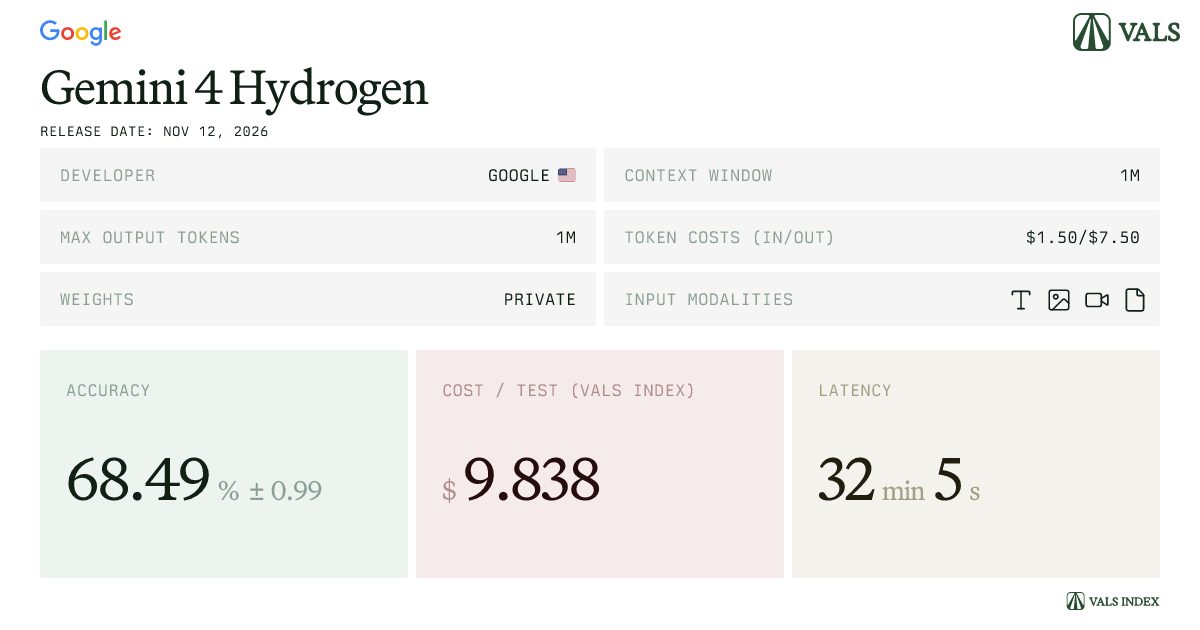
Vals AI publishes a public model page for google_gemini-4-hydrogen with its own evaluation figures.
No comments yet — be the first.
Vito Ruocco published a six-prompt creative-coding comparison of Gemini 4 Hydrogen and Gemini 4 Argon, including the billed token costs from his runs.
No comments yet — be the first.
Steffen Zahn at Notebookcheck wrote about how Google describes Gemini 4 Hydrogen access for free Gemini app users and Google AI Plus subscribers.
No comments yet — be the first.
The GitHub repository techkwon/hydrogen-vs-astra publishes materials for a five-round WebGL2 comparison the author describes as Gemini 4 Hydrogen versus GPT-6 Astra.
No comments yet — be the first.
The repository shibatamago-dev/gemini-4-hydrogen-hands-on publishes tasks, scoring code, and results for a hands-on comparison of Gemini 4 Hydrogen and Gemini 3.8 Flash.
No comments yet — be the first.
The repository ecooxai/gemini-4-hydrogen-antigravity-pixijs3d-web is a procedural PixiJS v8 3D character viewer, with the repo name crediting Gemini 4 Hydrogen and Antigravity.
No comments yet — be the first.
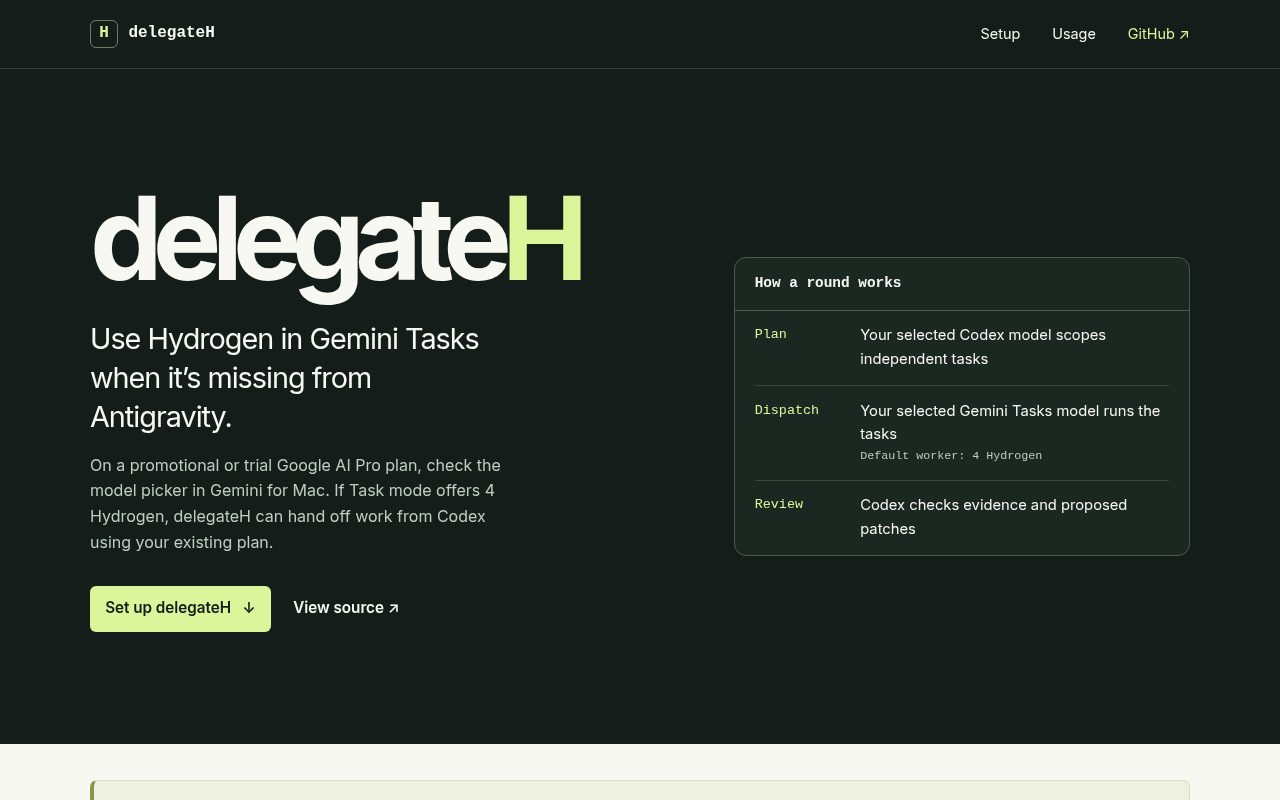
The repository HighTierRoach/delegateH describes a Codex skill for coordinating Gemini 4 Hydrogen workers through Google Antigravity, with a public documentation site.
No comments yet — be the first.
EvoLink publishes a product page that lists Gemini 4 Hydrogen API access, pricing, and thinking levels on its platform.
No comments yet — be the first.
Kira at eesel AI published a written review of Gemini 4 Hydrogen.
No comments yet — be the first.
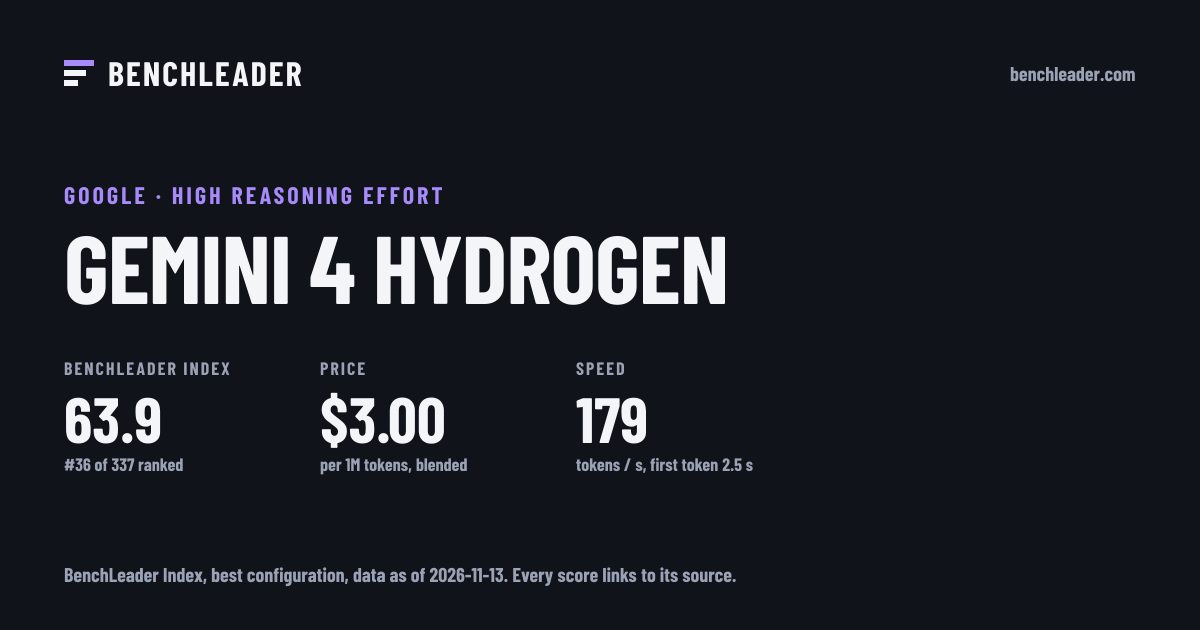
Benchleader lists a Gemini 4 Hydrogen model page with third-party benchmark figures.
No comments yet — be the first.
The channel AI with Surya published a YouTube video about Gemini 4 Hydrogen, with a title that refers to a speed test.
No comments yet — be the first.
The channel RepoChad published a YouTube video comparing Gemini 4 Hydrogen with Gemini 3.8 Flash, with a title that questions a speed claim.
No comments yet — be the first.
The channel NERD UP published a YouTube review focused on Gemini 4 Hydrogen coding performance and Orchestrator mode.
No comments yet — be the first.
Fahd Mirza published a YouTube walkthrough introducing Gemini 4 Hydrogen as an everyday Google model.
No comments yet — be the first.
Paul J Lipsky published a YouTube video whose title presents it as a personal test of the newly released Gemini 4 Hydrogen.
No comments yet — be the first.
The channel Lifey Guy published a YouTube video about the newly released Gemini 4 Hydrogen.
No comments yet — be the first.
Bijan Bowen published a YouTube video billed as a full test of Gemini 4 Hydrogen, comparing it with earlier Flash-class models.
No comments yet — be the first.
The account @patience_cave posted a chart of MazeBench scores the author lists for Gemini 4 Hydrogen, Claude Sonnet 5.5, and GPT-6.1 Terra.
No comments yet — be the first.
The official Parallel account (@p0) posted that Gemini 4 Hydrogen had been added to its Search Capabilities leaderboard, with a chart.
No comments yet — be the first.
Leo (@leo114119) posted a visual comparison of SVG gamepad drawings attributed to Gemini 4 Hydrogen and GPT-6.1 Sol.
No comments yet — be the first.
Haleemah (@Haleeeemahh) posted a side-by-side video of 3D koi-pond scenes the author says were built with Gemini 4 Hydrogen and Claude Sonnet 5.5.
No comments yet — be the first.
Tony (@EnvolDev) posted a timed, billed comparison of Gemini 4 Hydrogen and Gemini 4 Carbon on the same work, with a video of the run.
No comments yet — be the first.
In a three-part series, camper (@camperaigg) posted videos of Gemini 4 Hydrogen generating Three.js scenes: a voxel Chinese mountain temple, an ice crystal, and a shattering pot.
No comments yet — be the first.
The account @BuilderGuest posted a short clip the author describes as a Three.js frog-pond scene generated with Gemini 4 Hydrogen.
No comments yet — be the first.
Simon Willison (GitHub user simonw) opened and merged a pull request that adds Gemini 4 Hydrogen prices to the llm-prices repository.
No comments yet — be the first.
Piotr Olszewski at Promptowy published a Polish-language hands-on test of Gemini 4 Hydrogen on a 23-task set, with the author’s own cost and timing notes.
No comments yet — be the first.
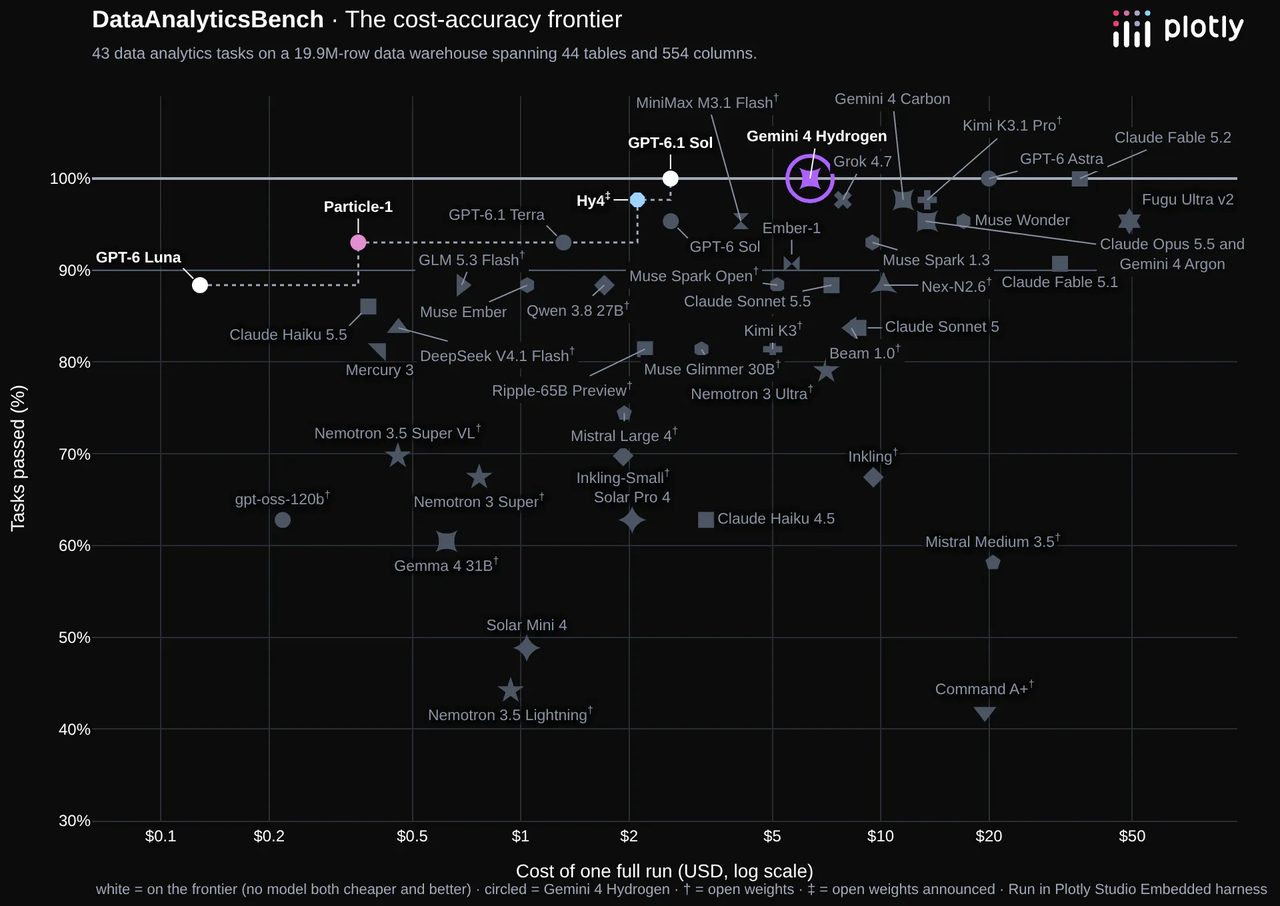
Plotly published a blog post describing how Gemini 4 Hydrogen performed on the company’s PlotlyDataAnalyticsBench data-analysis evaluation.
No comments yet — be the first.
In a Hacker News comment, Simon Willison linked SVG pelican drawings he attributed to Gemini 4 Hydrogen, Argon, and Carbon.
No comments yet — be the first.
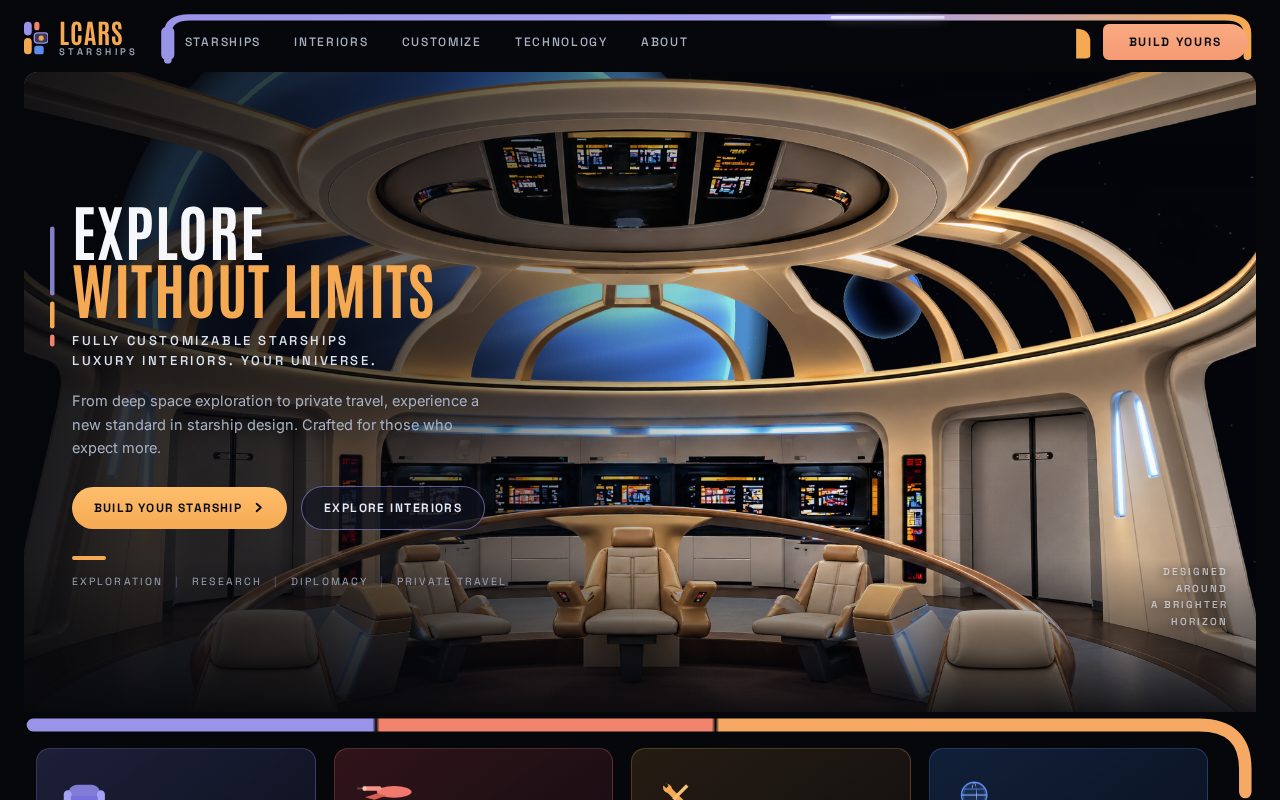
In a Hacker News comment, jjcm linked a live demo that turns an LCARS-style image into HTML and attributed the result to Gemini 4 Hydrogen.
No comments yet — be the first.
The repository locriani/benzene-langgraph describes a LangGraph whose nodes use Gemini 4 Hydrogen and Carbon, with a Kekulé benzene motif.
No comments yet — be the first.
Matthias Bastian at The Decoder reports on the Hydrogen announcement and compares Google’s published scores with those of Gemini 4 Argon, which had launched weeks earlier.
No comments yet — be the first.
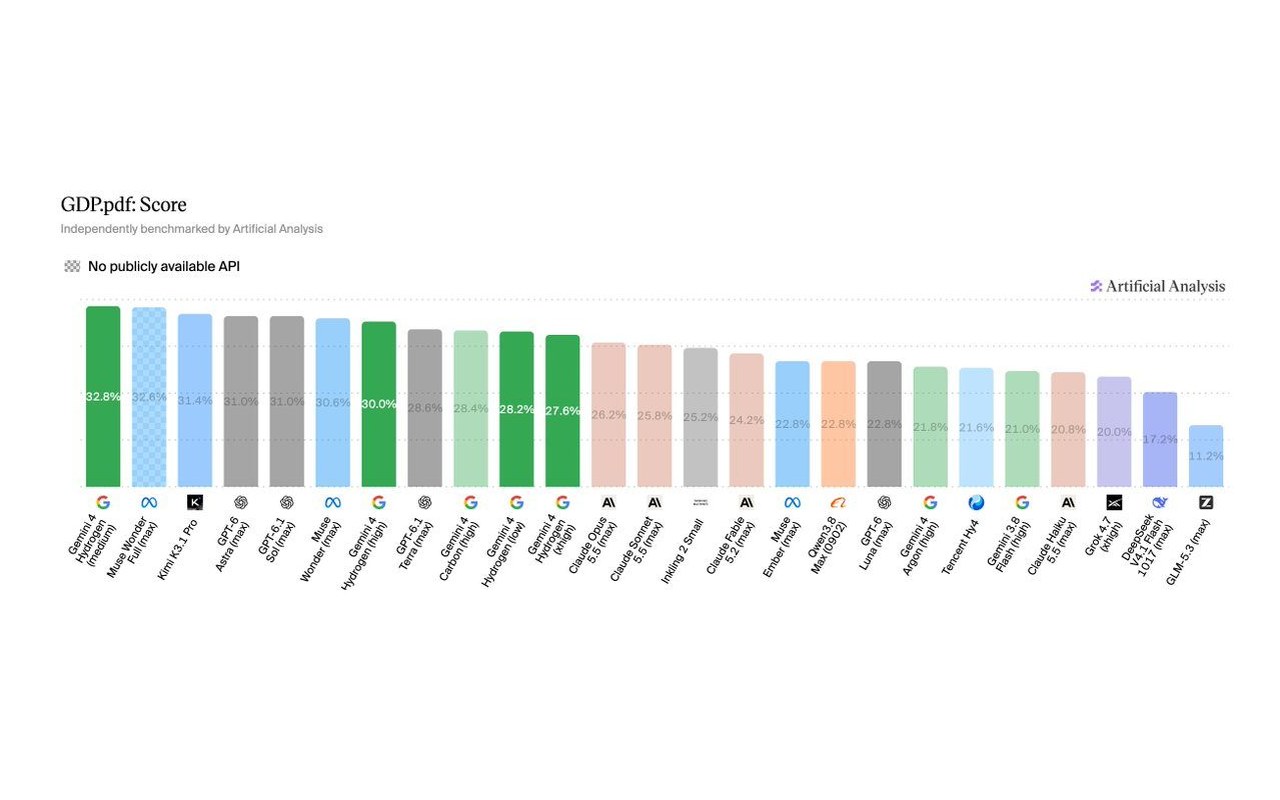
Artificial Analysis maintains a public Gemini 4 Hydrogen model page and posted on X that the model tied for first on a GDPVal-style evaluation at medium reasoning.
No comments yet — be the first.
Only work that is already public: a post, video, repository, review or demo with a stable URL. We credit the author and link back. We do not invent cases or add private material.
A page-level thread for this collection. Same rules as comments on individual cards.
No comments yet — be the first.