Hydrogen costs $1.50 / $7.50 per 1M input/output tokens. 3.8 Flash is $0.75 / $3.75 until 31 Dec 2026, then $1.50 / $7.50 from 1 Jan 2027 — the same as Hydrogen. Google reports Hydrogen at 57% vs 18.2% on Terminal-Bench 4.1 and 2.5× faster at its default high thinking level.
Official paid-tier list prices and published limits, retrieved 13 November 2026.
Gemini 4 Hydrogen
Gemini 3.8 Flash
Price now (paid, per 1M)
$1.50 input / $7.50 output
$0.75 input / $3.75 output, through 31 December 2026
Price from 1 January 2027
$1.50 / $7.50 (no change is listed on the pricing page we read)
$1.50 input / $7.50 output
Cache read / 1M
$0.075, implicit caching only (explicit caching is not supported)
$0.075 through 31 December 2026, then $0.15 from 1 January 2027, plus storage at $0.50 / 1M tokens per hour through 31 December 2026 and $1.00 / 1M tokens per hour from 1 January 2027
Context / output
Unified 1,048,576-token window; long decode up to 1M output tokens (Hydrogen announcement and pricing pages)
Thinking is listed as supported at low, medium, and high. The Flash model page we read does not list xhigh.
Free tier (API / AI Studio)
Free of charge, rate-limited
Free of charge (listed on the pricing page)
A worked cost example (arithmetic only)
This is our arithmetic on the official paid-tier list prices, not a figure published by Google. It ignores cache hits, batch discounts, grounding fees, and free-tier usage. For 10M input tokens plus 2M output tokens in a month: Hydrogen is 10 × $1.50 + 2 × $7.50 = $15 + $15 = $30. Flash is 10 × $0.75 + 2 × $3.75 = $7.50 + $7.50 = $15 through December 2026, and $30 from January 2027.
What Google claims (quoted, attributed)
On Terminal-Bench 4.1, the announcement blog reports Hydrogen at 57% versus 18.2% for 3.8 Flash, “finishing tasks 2.5 times faster at its high default setting,” and “cutting fabricated claims by more than 5x.”
The same blog says that “in early testing across complex graphs, SQL, and data-heavy enterprise workflows, our partners have seen Hydrogen run 2x to 2.8x faster while reducing token usage by 12% to 23%, compared to 3.8 Flash.” Those are partner results Google reported; we have not seen the underlying tests.
Vals AI’s model page (retrieved 13 November 2026) lists Hydrogen at 54.04% on Terminal-Bench 4.0 (rank 11 / 64) and 68.49% on the Vals Index (rank 6 / 37). That is a different Terminal-Bench edition than Google’s 4.1 figure, so the two percentages should not be ranked against each other. Vals AI: Gemini 4 Hydrogen. We have not rerun these evaluations.
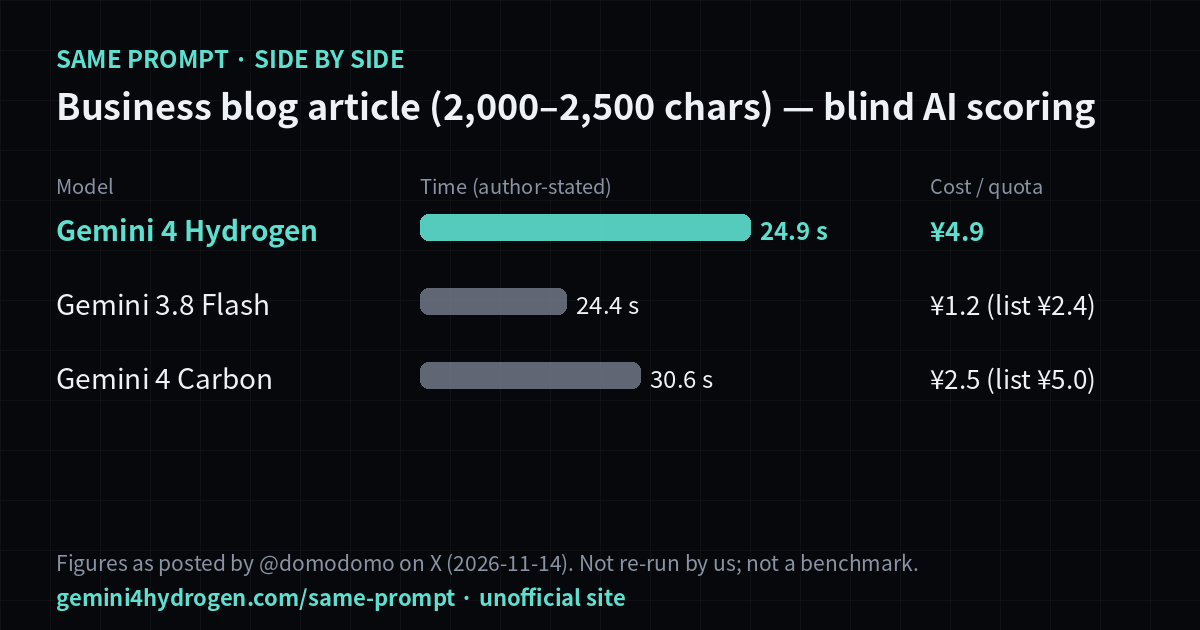
Same system prompt and task for all models, per the author; outputs were anonymised and scored twice by an AI judge (Hydrogen 98, 3.8 Flash 97.5, Carbon 83). Hydrogen's 3,143 thinking tokens drove its higher cost. The author's runs, not a benchmark.
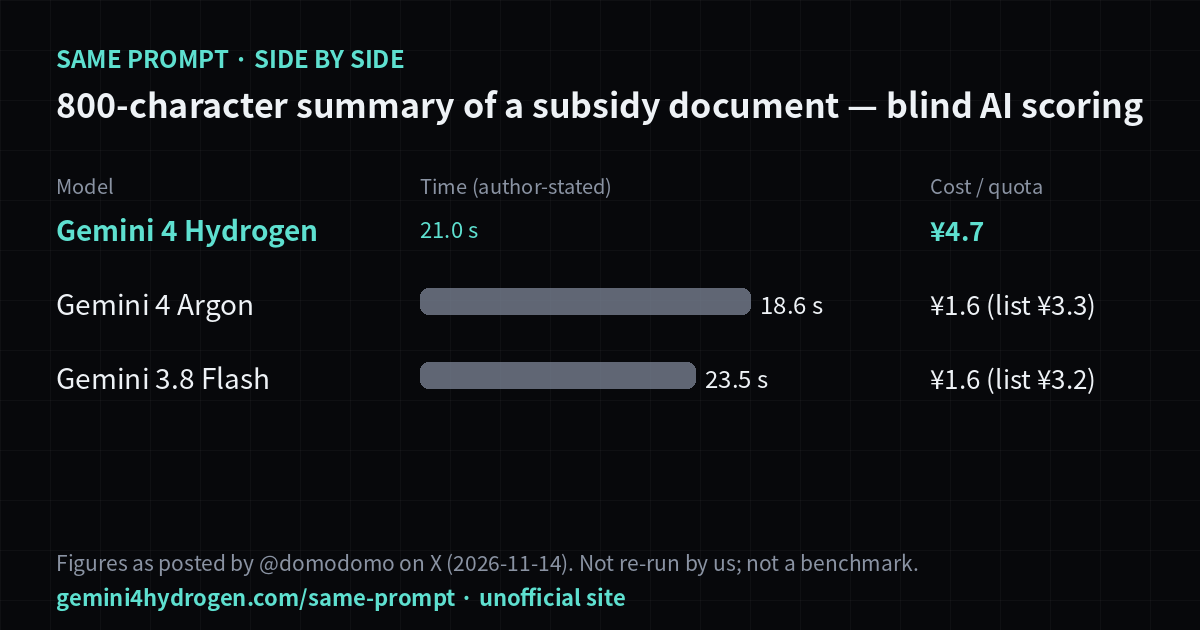
Same instruction for all models, quoted in the post ('only from the material… write 資料からは不明 where unclear'). Scores per the author's AI judge: Hydrogen 97.5, Argon 95.5, 3.8 Flash 84.5 (it omitted the required 'unknown' note). Not a controlled benchmark.
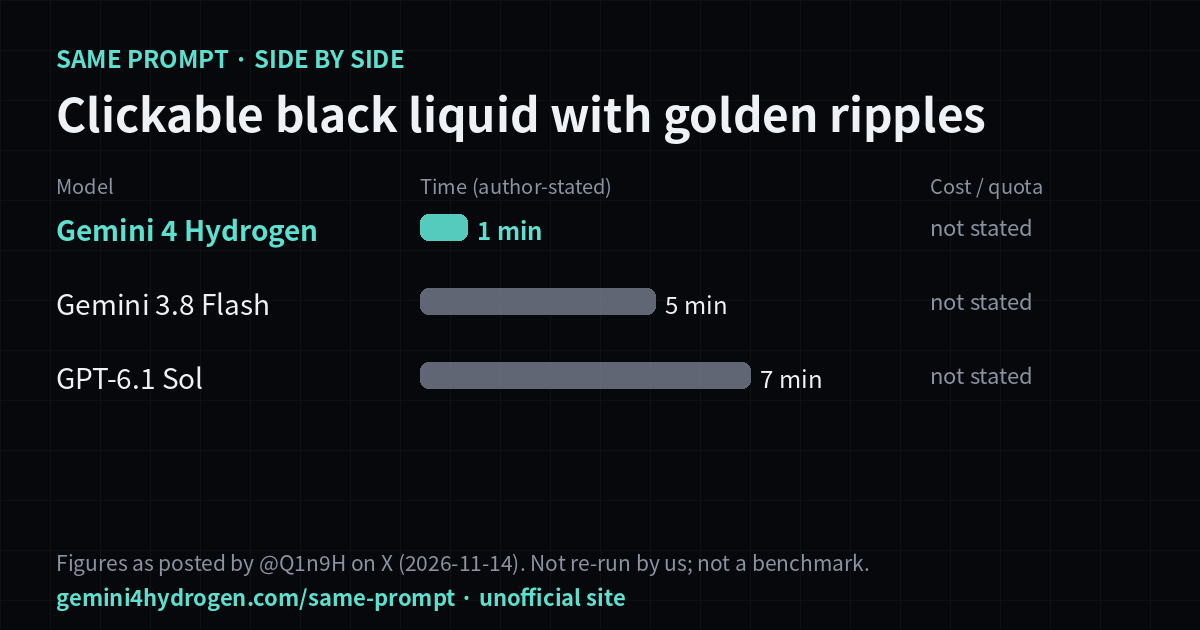
Same task (prompt not shown identical) · @Q1n9H, 2026-11-14
Model
Time
Cost / quota
Gemini 4 Hydrogen
1 min
not stated
Gemini 3.8 Flash
5 min
not stated
GPT-6.1 Sol
7 min
not stated
Author reports these timings for the same liquid-surface task; Hydrogen's scene was not as good as Sol's. No cost, exact prompt or effort setting published.
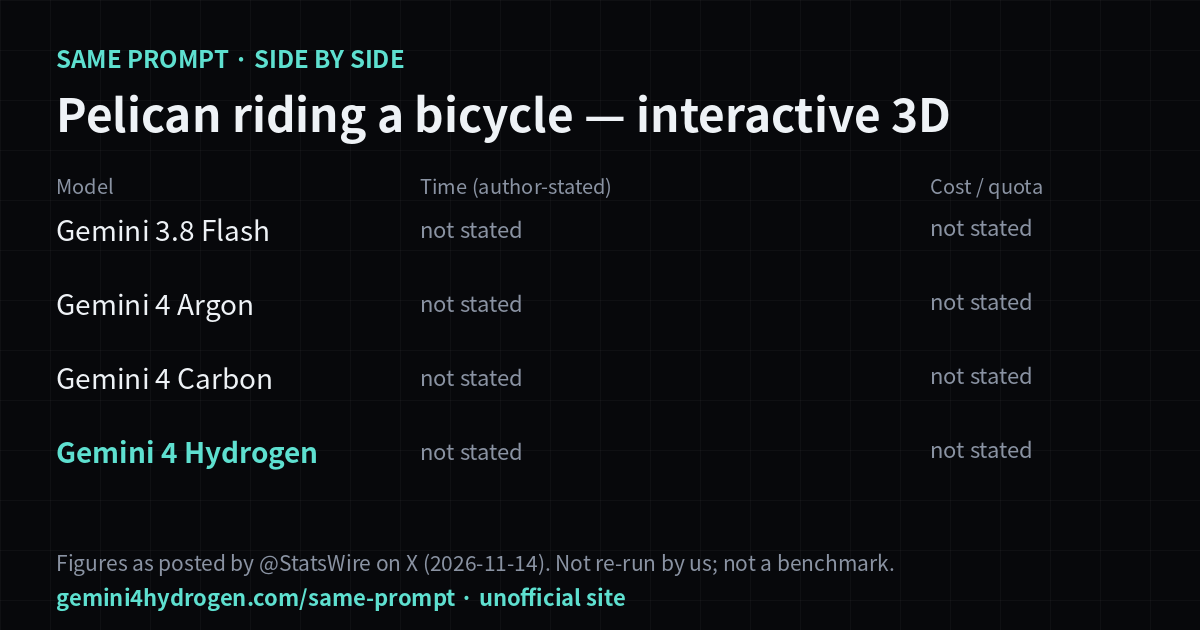
Same task (prompt not shown identical) · Flash / Argon / Carbon: Max; Hydrogen: Extra (author labels) · @StatsWire, 2026-11-14
Model
Time
Cost / quota
Gemini 3.8 Flash
not stated
not stated
Gemini 4 Argon
not stated
not stated
Gemini 4 Carbon
not stated
not stated
Gemini 4 Hydrogen
not stated
not stated
Four outputs of the pelican task, not four measured speeds. The author did not publish time, cost or full prompt text. Effort labels differ. Watch the embed; no winner is inferred.
At its default high level, Hydrogen measured 171 output tokens/s and 8.3 minutes per Artificial Analysis Index task; the fastest level of the other model here measured 114 tok/s, so Hydrogen streamed about 1.5× as fast in AA’s runs.
Measured independently by Artificial Analysis on each vendor's own API (retrieved 14 November 2026); speed is averaged over the past 5 days and changes. A dash means AA had not published that figure. This site did not run these tests.
Model · thinking/effort level
AA Intelligence Index
Output speed (tok/s)
Minutes per AA Index task
Time to first answer token (s)
Gemini 4 Hydrogen · xhigh
54
178
14.5
44.79
Gemini 4 Hydrogen · high
51
171
8.3
17.37
Gemini 4 Hydrogen · medium
41
174
3.8
11.81
Gemini 4 Hydrogen · low
27
173
1.4
5.58
Gemini 3.8 Flash · high
31
114
14.5
17.12
Gemini 3.8 Flash · medium
30
111
12.4
13.42
Gemini 3.8 Flash · low
23
102
—
4.30
The task-cost columns are our arithmetic on official list prices, assuming every model uses the same token counts — they do not (see output volume below), and Anthropic says its newer tokenizer produces about 30% more tokens for the same text. No cache, batch, or grounding fees. The last column is Artificial Analysis’s own measured average, at the prices AA used, for the variant named in brackets.
Model
Official list price (input / output per 1M)
Our arithmetic per task (50K in + 8K out)
×1,000 tasks
AA measured cost per Index task
Gemini 4 Hydrogen
$1.50 / $7.50 flat
$0.135
$135
$3.16 (xhigh)
Gemini 3.8 Flash
$0.75 / $3.75 through 31 Dec 2026; $1.50 / $7.50 from 1 Jan 2027
$0.068 (to 31 Dec 2026) $0.135 (from 1 Jan 2027)
$68 $135
$7.77 (high)
Output tokens Artificial Analysis recorded while running its whole Intelligence Index (more tokens = more cost and time for the same work): Gemini 4 Hydrogen: xhigh 304M, high 110M, medium 54.4M, low 20.3M; Gemini 3.8 Flash: high 126M, medium 83.9M.
Based on Google’s official Hydrogen migration guide (retrieved 14 November 2026). The checkboxes are local to this page, not a claim that we tested your integration.
gemini-3.8-flash → gemini-4-hydrogen.
Hydrogen defaults to high (Flash defaulted to medium), adds xhigh, and rejects minimal / thinking_budget. Test medium and high first; choose the lowest level that meets your quality bar.
Input + thinking + output share 1,048,576 tokens, rather than separate input/output budgets. Remove low hard-coded output caps (e.g. 8,192) or raise to 65,536; max_output_tokens includes thinking.
Remove cached_content, cachedContents and caches.create. Implicit caching is automatic on shared prefixes ≥4,096 tokens; put static instructions first and measure actual cache hits.
Remove temperature, top_p, top_k (ignored in range, 400 out of range), frequency_penalty, presence_penalty and candidate_count >1 (400). Do not prefill model turns.
Use previous_interaction_id for Interactions. In client-managed history replay every original thought_signature. In parallel calls only the first functionCall carries it; keep calls in one model turn, then responses in one user turn. If compacting earlier history, set prefix_mismatch_behavior=DROP.
Do not prompt for raw-text JSON tool calls with no declared tools: that can return MALFORMED_FUNCTION_CALL. Use function declarations or structured outputs.
For >65,536 output tokens, set max_output_tokens above that and use background=true or SDK continuation. On Google Cloud long decode requires v1beta1; Interactions automatic continuation needs google-genai ≥2.34.0 or @google/genai ≥2.32.0. Evaluate on your own task suite before rollout.